December 26, 2009
Sorry I haven’t been keeping up the blog this last week. I said I would have some articles to put up on it, but life got in the way. Work and illness.
2009 has been, without doubt, the second worst year of my life. I haven’t said much about it during the year, because I don’t like to complain, and it would be tiresome to hear it too. But I always look for meaning in even the bad things that happen to us. This year, I have learned to be sympathetic to those in pain, in a way that you can only when you’ve experienced pain. I hope to bring that sympathy with me through to 2010 and beyond.
As much as I can find purpose in this dire year, I really want a better one for next year. Come January, I plan to set about making it just that.
This year I learned something about my writing too. I’m not as talented a writer as I thought I was. Actually, it’s not that I thought I was hugely talented (in some vain way), it’s that I just always assumed I had what it takes to “make it”. In the end, despite what anyone will tell you, publishing, like life, is a bloody lottery, even though you do your best. What I do about that in 2010, we’ll see.
For now 2009 is limping to a close, and me right along with it. I’m exhausted. Blindsided by a bad year that came out of nowhere. And a stomach bug over Christmas too, just to see out the year consistently! But I’m looking forward to the new year of hope.
I won’t wish you all a happy new year, because we can’t know what will come our way. However, I wish that you learn to have a good 2010, in all its sorrows or joys.
Entry Filed under: Observation & Musing
December 18, 2009
I was ambivalent about going to watch Avatar. The trailer, as with many Hollywood trailers nowadays, doesn’t leave a taste of mystery, but rather exposes too much of the thrust of the story, and revealed it to be a fairly standard, even cliched, tale.
And so it was.
Dances with Smurfs, as South Park lampooned it.
The story wasn’t a surprise, but the visuals were. The sheer amount of them. They were endemic in the film. In 3D, the film certainly looked 300 million dollars (or whatever it cost). With a budget like that I suppose the last thing they could afford to do was take risks with the story. It ticked all the psychological boxes, straight out of film-writing school: hero with a goal that changes half way through, meets beautiful girl, falls in love, earns the hand of said young blue maiden, big battle with the baddies at the end, good prevail over evil.
The themes of the story are surprisingly prescient, considering the story must have been written years earlier. James Cameron tapped into the zeitgeist of the time, and it seems even stronger now. Like many American films, the military figures dominantly, but this time they are the bad guys (or rather the unquestioning warmongering mentally is the enemy). It has a strong ecological theme too. It reminded me, in many ways of Final Fantasy. Remember that one? The last great reinvention of film, before Avatar. How quickly we forget reinventions!
One of the striking differences of the visuals in Avatar is the use of colour and light. Why is it that CGI has always been to represent dark a gloomly things thus far? It was nice to see something artificial realized so vivaciously. It enhances the themes too – the good guys full of colour and light, and their militaristic counterfoils in bland steel greys and muted khakis.
Is it the groundbreaking reinvention of cinema claimed by the hype? No: after all, how many films will have a budget like that? Perhaps it is a milestone though, a landmark consolidation of the state of CGI, thanks again largely to Weta Digital. The reinvention will come when such quality visuals become even more affordable for the average film budget of a non-blockbuster film that can afford to take risks with more original stories.
My expectations were low, but I did enjoy it more than I expected I would. At the very least, Avatar is a fantastic, immersive, vibrant, and entertaining sojourn from the real. Much needed in these times.
Entry Filed under: Reviews
December 14, 2009
Dealing with corporate clients, handling their last minute rush requirements that absolutely have to be done by Christmas (happens every year!) got me thinking about the megacorps of publishing. The megacorp of publishing – Amazon. Ok, so bear with me. I’m have a suspicious mind. It comes from reading and writing all those thrillers.
When I first considered self-publication a year ago, BookSurge was the candidate. In the meantime, it has been subsumed into the great belly of the Amazon beast. Not long after, Amazon stated that the only vanity press they would list on their site was … BookSurge (CreateSpace as it has recently been renamed).
There’s the rub. And a portent of the future. That was a clear case of Amazon leveraging it’s online market dominance to push out other vanity presses, and so maximize its profits from that sector of the market. It is a common strategy of all megacorps, like Tesco and Walmart. Suppliers are so glad to get into chainstores like those, that they will take a financial hit for the sake of wide exposure. And the megacorp will squeeze them financially, because they know they will take it.
In the Internet age, if we are not vigilant, we will live in an age of monopolization of the distribution channels. The companies who control the distribution channels set the rules of the game, and can squeeze suppliers.
So who are Amazon’s book suppliers? The publishers? Yes and no. Mostly no. Because it is the authors who actually make the product. Amazon knows this. This is why CreateSpace makes such sense for them, especially in the long term, as I will explain shortly. If they capture the huge volume of vanity published authors, it doesn’t matter if they sell only a few books on each. Amazon aren’t fussy, because one person’s buck is as good as any other. Multiply a few book sales out by the volume of vanity authors they can capture (remember, they control the main distribution channel). And they can charge the author for the privilege of using their vanity services too (the willing supplier will be squeezed gladly for access to the distribution channel).
Publishers aren’t really the suppliers. They are the middle men in Amazon’s paradigm. Amazon need publishers for now, of course, because Dan Brown’s latest will drive browsers to Amazon in droves. But in the future … who knows. Apart from squeezing supplier’s profit margins, the other strategy megacorps use to maximise profits is shortening the supply chain. On the Internet, this is known as disintermediation. The middle men are kicked out, because the distribution costs are kept low, and the Internet company can connect supplier directly to customer. Authors linked directly to customer, by Amazon alone. Internet companies will use and tolerate any intermediary only so long as it makes financial sense for them. With Borders bookstores closing daily, will Amazon grab some high street pick-up points for their consignments on the cheap in a recession? If Amazon become the distribution channel for books, what’s to stop them signing contracts with Dan Brown once his contract with his publisher expires? What’s to stop them from setting up an X-Factor book site to crowd-source the next Dan Brown from the ranks of all the CreateSpace authors?
Publishers beware. And watch what Amazon is up to. Gradually, Amazon’s interests may be to push the publishers out of the chain and deal with authors directly. Small shifts, inexhorably, over time. Too suspicious for you? It’s not just me: Publishers need Amazon – but do Amazon need publishers?
The big worry, in such a doomsday scenario for publishing, is who would be left to fight back against the megacorp in the author’s interest?
But, for now, we’ll all happily use them. They’ve got the biggest, best distribution on the Internet. Right?
Entry Filed under: Indie-Publishing
November 16, 2009
Here at Optimistic Future Publishing Enterprises we are always on the look-out for excellent candidates to fill our job opportunities as fiction novelists.
The successful candidate must have the following:
- An original manuscript, already completed, to our satisfaction.
The successful candidate should also display some (but not necessarily all) of the following:
- Work well alone
- Work well in a publishing team
- Self-starter
- Self-finisher
- Imaginative
- Observant
- Attentive to detail
- Patient
- Persistent
- Ambitious
- Withstand criticism
- Self-motivated
- Can work to a deadline
- Deliver long-running projects with no management intervention
- Avid reader (hundreds of novels in your genre ideal)
- Mastery of at least one major international language
- Word processing skills
- Proof-reading skills
- Editorial skills
- Research ability
- Psychologist
- Philosopher
- Good people interaction skills
- A large social network of friends
- Tireless self-promoter
- Knowledge of the latest marketing strategies
- An active blogger (a back catalogue of many years worth of blog posts is ideal)
- Frequent twitterer
- A keen observer of publishing trends
- A keen observer of social trends
- Media savvy (some training preferred)
- Knowledge of libel & slander laws
- A high public profile (celebrities preferred)
- Public-speaking experience
- Loves to travel
- Young
- Attractive
- Interesting
- G.S.O.H.
- A strong arm (whichever one you sign with)
If this sounds like you, we want to hear from you! For the right candidate, renumeration is negotiable(*).
* Renumeration is on sales commission basis only. No salary provided. Overtime will be required. Second income recommended.
Entry Filed under: Observation & Musing
November 5, 2009
I thought this was interesting, given my interest in all things genetic. A court has reduced a murderer’s sentence because he tested positive for genes believed linked to agression.
Is this yet another potential change in society that genetic knowledge will foist on us? Will we no longer be responsible for our actions, but merely considered slaves to our genes? A society built on lesser personal responsibility does not bode well.
If science has killed God … now sin is shortly to follow. Broken evolution indeed.
Entry Filed under: Observation & Musing
November 3, 2009

Image by William Hook
The iPhone has been grabbing my attention. As if to reinforce the now undoubtable shift in the publishing paradigm, it seems that the number of books being published as apps on the iPhone is growing … fast. Book apps releases in the appstore overtook game apps for the first time ever. 20% of the apps released in September were books. It seems publishers and indie authors are not waiting for the mooted Apple eReader, the one that’s easy on the eyes and the batteries (… yada, yada …), but rather are willing to take advantage of another distribution channel for eBooks here are now. And why not? There are, no doubt, more iPhones than eReaders out there. There’s a huge user base who scan the appstore everyday. Sure, there is eReader software like Stanza on the iPhone, but I can see the attraction of a custom app in terms of its attention, customization, regular updates, linked interactive content, options for free/purchase content, etc. I’m not the only one.
There’s early adopter advantage to be had here. After all, where is an Apple eReader likely to get its content? Are they likely to do a content distribution deal with a competitor like Amazon who have their own eReader to shift? I don’t think so. Maybe Google? Or Stanza. Or will they open up a bookstore of their own, just like they’ve done for every device they’ve made recently. Perhaps. The answer might be simpler than that. It wouldn’t surprise me that many of the books will just come from the appstore anyway, and run on the eReader as they would on the iPhone.
Perhaps its time to dust of my programming skills and write my first iPhone app. As I know from writing software for other handhelds, its not trivial — beyond the ken of most authors. Maybe I should make the fruits of that effort available to other authors and publishers too? Well, let’s see where it goes - that’s pretty much the mantra for the whole publishing business right now.
Entry Filed under: Marketing and Promotion
October 26, 2009
I’ve been searching reviews for a natural dietary supplement to see what it does and if it’s any good. The process brings me face-to-face with the real nature of the internet, and a lesson in marketing, during the very week I’ve been planning my own internet marketing strategy.

Image by inky
Upon searching for this particular supplement, I find that the reviews on the first couple of Google pages of links were all very positive. Nothing is so perfect. Perfection makes me suspicious. The reviews were similar in their wording. My guess is the marketing man (who shall remain nameless) from the company who make the supplement has entered into as many blog and review sites as he could find. SEO at its best … and worst. Manipulating search engines and saturating the bandwidth for those searching on the efficacy of a product is very shrewd marketing strategy, but I find it a little sad, because it erodes the internet’s usefulness as a resource for impartial, genuine, user reviews of a product.
Ah well, moral of the tale: if you want the genuine stuff, click straight to page 20 of the search results; if you want to sell stuff, get it into pages 1 and 2!
Entry Filed under: Marketing and Promotion
October 8, 2009
I heard good things about Windows 7 on netbooks. So I took advantage of my MSDN professional subscription to download it and install it on my Eee PC netbook. There were a few tweaks necessary to install it on the netbook, but hey, after thirty years doing this stuff, I’m used to that! Netbook specific install quirks aside, it installed fairly easily.
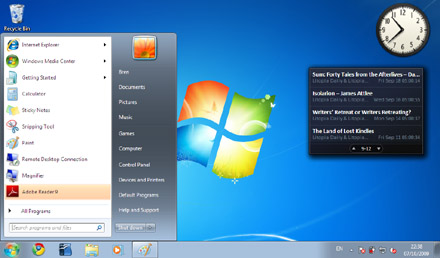
I must say, first hand, that Windows 7 has surprisingly good performance on a netbook. Microsoft got worried about loss of market share to Linux on netbooks and so took the netbook market very seriously in Windows 7, and it seems to have worked. It performs at least as fast as my old Linux installation, and faster in some ways. Running Google Chrome on Windows 7 responds faster than Firefox on Linux (Chrome has a very fast JavaScript engine – Google’s speciality). The new OpenOffice 3.1 boots up faster on it too. Writing should be a breeze – no excuses now. Lets see how fast it stays when I install the software development tools on it!
They have improved some of the problems Vista had. The annoying UAC pop-ups seem to have gone, now only asking me when it really needs to check access permissions (like the first time a new device driver is installed). The user interface feels a lot “smarter” – the result of lots of little tweaks to it. Cleaner too. Everything seems to be easy to find, where you need it, when you need it, and no clutter. The only downside so far is that shutdown takes a long, long time on my relatively slow SSD drive. But, I’ve set it to hibernate instead of shutdown all the time, which is quicker, and means it can start-up much faster too.
So overall, I’m happy with Windows 7 … so far!
Entry Filed under: Reviews
September 4, 2009
I’m winding down to my long overdue vacation. Lately, I feel like I’ve been shooting into the fog, hoping to hit something. The final round of agent submissions felt like that. The attempts to heal my sciatica have felt like that. No targets hit so far, and worse … I can no longer see where the targets are, or what they are. Weariness from a year of constant pain has fogged it all over.
So I’m off for two weeks, to relax, recharge, and re-focus.
To keep myself going until that break, I decided to play around with the Gunning-Fog Index and the Flesch-Kincaid Test this week. You could be forgiven for mistaking them for obscure titles of gripping thrillers, but actually, they are metrics for grading the readability of text. It’s based around sentence and word length. I applied it to some chapters of my novel. The readability was quite good, but by adopting some of the change suggestions from Edit Central, I found I could improve every chapter by almost a further point, which brings it comfortably into my target audience range.
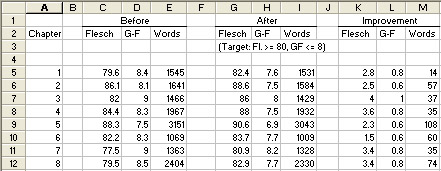
I might apply it to the whole novel when I return. Tighten it up even more. I wouldn’t recommend applying it blindly as an editing technique. It’s just interesting, that’s all. It makes me more aware of my style, and where it could trip up a reader. It made me think of even simpler, clearer ways to compose some sentences.
The most interesting thing of all, for me, is that readability was hardest in chapters where certain people were talking. This is mainly because those people would be having some technical conversations (with lots of multiple syllable words like ‘forensics’ or ‘genetics’). I could almost tell which chapter it is by the readability index alone. (I’m too damned close to this thing!) Is editing ever truly finished? Or am I just gilding the lily at this stage? Time to let go.
Ah well – holiday time too. Back in a couple of weeks.
Entry Filed under: Editing
August 27, 2009
Back injuries got me thinking mortal thoughts lately. Contemplating a long-running ailment made me consider that my youth is at an end (physically at least). Early this morning I watched a discussion on breakfast TV about ageism – it is discrimination, but the guest was making the point that it is a very subtle form of it. There’s just an assumption that as we get older, we can do less. It has been said (by Dorothea Brande) that writing is something to be considered only after you reach the age of thirty. The quality of writing is one of those things that – arguably – improves with the age of the author. Which is probably just as well, since recent rejections have me thinking that if I want to be in this at all … it has to be for the long haul!
It makes me think too of our youth-centered culture. Marketing gurus love “yoof”. Reinvent and recast. Bring the most beautiful and appealing onto screen and stage. I’m thinking of the youngest actor ever cast to play Doctor Who. I’m thinking of a new young Star Trek film cast. I’m thinking of the rumour that Stargate: Atlantis was cancelled to make way for Stargate: Universe – a show which will, no doubt, be another pale Star Trek style rehash, but with a younger cast to appeal to a larger demographic. I’m thinking of the trend in recent years of announcing book deals with teenager authors, the kind whose pictures look pretty next to the byline. I’m not resentful – more luck to them I say. I’d have loved to be in that position when I was that young. But I held off, knowing that my work wouldn’t start to be of a quality I’m happy with until this stage of life.
Of course, there is another reason the marketeers like this youthful shim on our world – inexperience comes cheap. It is the beauty of the healthy balance sheet they like to ogle.
Entry Filed under: Observation & Musing