September 11, 2026
I realise it may be letting the side down to acknowledge that AI actually has valid uses for the work of a writer. It seems to me that, to be a writer at the moment, there's an unstated code in the profession that you have to hate AI, if not actively campaign against AI.
I am against using AI generated text as much as the next writer, but I do see its usefulness to me in my work.
AI as we call it today is actually a set of Large Language Models (LLMs). As the description implies, it is the latest evolution in computer parsing, understanding and generating of language text. So surely it could analyse the style of my writing. I unleashed it on an essay I'm working on.
On the following piece of writing, analyse my writing style and tell me how you would define and describe it
The response?:
Your style is conversational essayistic with a polemical streak.
Was that a compliment or an insult?
To elaborate, apparently my distinctive traits as explicated by the AI were:
Conversational authority. You write in first person with a confident, occasionally wry voice. You reason on the page rather than presenting finished conclusions.
Rhetorical patterning through repetition and antithesis. You lean on parallel structures and contrasts. There's an aphoristic instinct at work — sentences are crafted for quotability, not just information.
Argument by juxtaposition rather than strict argument. You move between registers and trust the reader to assemble the throughline. This gives the writing energy and a personal, blog-like voice, but it also means transitions sometimes carry more weight than the connective tissue can bear.
Concrete detail anchored in lived experience. That specificity is a real strength; it keeps abstract arguments grounded.
Epigrammatic closers and callbacks. You like ending sections on a pivot. There's a consistent wit here.
I don't disagree with that. It's particularly useful to know my connective tissue isn't strong enough for some of my transitions (whatever that means!) It certainly gave me a unique perspective on my style and much to think about. While it is valuable to know the positive characteristics of your writing, it's even more valuable to know its weaknesses. The AI even offered some unsolicited advice on that:
Abstraction creep. You sometimes coin terms faster than you cash them out.
Density over rhythm. Some paragraphs carry three ideas at once; a reader can lose the thread even when each sentence is individually clear.
Unresolved tension. You introduce a counter-position, but the essay doesn't fully dramatize that tension — it stays asserted rather than dramatized.
It should be noted this was a first draft text, and I have different styles for essays and fiction. Some of the aspects raised are ones I usually address in subsequent drafts. For example, I particularly agree with the second point, in that my first drafts always cram too many ideas in too little a space. I end up breaking a lot of them up and adding more expository sentences.
Of course, an AI judgement will never have the quality of assessment of a human editor, or a human reader. It can never tell me how my writing made it feel.
So my conclusion to AI as a style guru? As I so often conclude on all topics AI lately: it has some interesting things to say, but will never replace the truly human.
So ... how does that make you feel? :)
August 25, 2026
My history of writing seems to have been one of restarts. Hopefully the engine won't stall again this time.
Writing - as every writer knows - is not a lucrative business. For me, writing had been relegated to hobby status again, because I couldn't justify spending much time while I needed to earn a living. My main career in IT had always been a lucrative one. Now the vagaries of the IT industry have given me the time and opportunity once again to embrace writing. It is challenging to return to it "cold turkey" (my relationship with words in recent years has been in the form of computer code!) It feels like my writing is stilted, very "right brain." I need to get back into the discipline first - into the writing gym so to speak - and practice the art again, to find that flow necessary for prose and fiction, and to re-find my voice.
To start this time, I intend to focus on short stories and articles for a while before I launch into something as significant as a second novel. I've had stories published in the past (writing under a different guise) by the ESA (European Space Agency) and the James White Award. I need to reach that level of independent validation again, to be accepted by an editor, in order to know that my writing is ready again.
There is a sadness also that gives impetus to my return to writing. My uncle passed away recently. He was an author, a broadcaster, and an educator. Teaching never left him. Even in the months before his death he was still doing school visits, inspiring pupils, and encouraging them to use their imagination and their talents. I remember the words he wrote to me when he read my novel: "What an achievement!"
He was a friend of the late poet Seamus Heaney, and was fond of quoting his work. In fact, my uncle's memorial card carries words from the poem Station Island. The same words were spoken by my uncle many times to encourage budding writers. In the poem, the author imagines the great Irish writer James Joyce speaking to him, encouraging him. They are words that speak to me now, from many sources.
...‘Your obligation
is not discharged by any common rite.
What you do you must do on your own.
The main thing is to write
for the joy of it. Cultivate a work-lust
that imagines its haven like your hands at night
dreaming the sun in the sunspot of a breast.
You are fasted now, light-headed, dangerous.
Take off from here. And don’t be so earnest,
let others wear the sackcloth and the ashes.
Let go, let fly, forget.
You’ve listened long enough. Now strike your note.’
Standing on the shoulders of giants, I owe it to all those generations of writers - now gone - to strike my own note. I cannot hope to match their talent, but I can only (and must) strive to use my own, and not let this generation end without making my written contribution.
Time to return to my office.
Entry Filed under: Writing, Observation & Musing
February 2, 2021
All the talk recently of The Great Reset got me thinking about what it all means for publishing. I’m undecided on whether this supposed reset will happen, or perhaps take a different form than what many people currently envisage. The prospect of it happening at all merits consideration of the potentially tumultuous consequences for all of human society.
The prospect of the mooted universal basic income intrigues me. We’ve seen the seeds of it in the pandemic furlough schemes**. Many writers already find it hard to make a living from their art, and have to augment with some other income anyway. So is UBI a potential boon for authors? For all “creatives”, for that matter.
People who can survive on a basic income from the State will need things to do with their time. The prospect of a large number of people at a loose end, without any obligation for participative contribution to society, is one that should worry us. But those who are perhaps naturally drawn to creative arts will see UBI as a means to an end, as a means to allow them to do the thing they most want and love to do – to create art for the greater good.
This may be no bad thing. Great writers who may not have otherwise come to light may emerge only because of UBI support, but a word of warning to any aspiring author in such a scenario – it will also mean lots of additional competition (for want of a better word) for the attention of publishing houses. Many more bored scribblers on UBI flooding the slush piles with their manuscripts might not be a thought that excites many in the publishing business at the moment! Those who can’t get publishing contracts will go the self publishing route (as if the amazon book lists aren’t already chock-full of indie publications diluting the attention of would-be readers too.)
On the bright side though, more people with more time on their hands means more people likely to pick up a book to read. So perhaps we can look forward to a reset in reading habits too, just as we saw during these pandemic lockdowns. More readers is good news for any publisher and ultimately for any author that can scramble to the top of the increasing slushpile.
** How these schemes will be paid for – or indeed whether they should be paid – in the longer term is a whole other discussion, but that’s a different post.
Entry Filed under: Indie-Publishing
August 4, 2018
… I came across this passage while doing some research reading. In it CS Lewis captivates almost exactly the central theme of Broken Evolution:
If any one age really attains, by eugenics and scientific education, the power to make its descendants what it pleases, all men who live after it are the patients of that power. [..] The last men, far from being the heirs of power, will be of all men most subject to the dead hand of the great planners and conditioners and will themselves exercise least power upon the future.
– C.S. Lewis, The Abolition of Man
The only disagreement I would have with Lewis (-does one do such a thing?-) is in the notion that future man will exercise least power. Humans have the ability to prevail, endure, and transcend, no matter who we are, or how we are made. I think bio-engineered challenges for the human race are ones, for sure, that humanity will ultimately have to grapple in its own circumstances, and in so doing define and assert humanity once again, for another generation, in a future time – that’s the innate power of human nature.
If that power to question, discover, shape, and transcend is lost it will be because of nothing less than a loss of human nature. If that were to happen, could we even be considered human anymore? I choose to believe that won’t happen … but then, I’m human like that, you see.
Entry Filed under: Writing
June 15, 2018
I’ve squirreled myself away to a writer’s retreat for a few days. I’ve been to a couple of them in my time. Even alone in a cabin in the woods helps to free the mind from distractions and focus on a writing task, but writers’ retreats have the added bonus that you have the companionship of other writers around you. This, of course, can be a risky thing! Creatives can be a very wild and unruly creatures. I’m fortunate to be able to say, I’ve had no bad experiences. In fact, I’ve made some good friends and kept in touch. The advantage of being in such an environment far outweighs the risks. You get to meet up for meals and chat about writing and the work problems of the day, so you don’t feel isolated. And when writers scatter to their own cells to work after meals, one feels one must comply. It is a great environment in which to write.
The big disappointment is that it takes so long to get the city and work out of my hair, and to get into the writing routine – if not frame of mind – and once I have it’s a short time until I have to head back to the day job again, and the challenge then becomes maintaining that writing focus and discipline during life beyond the retreat. Wondrous will be the day when my time will be for one thing only – writing. I slightly envy writers that can write at the drop on the hat, on a train, or in a noisy cafe. Not I.
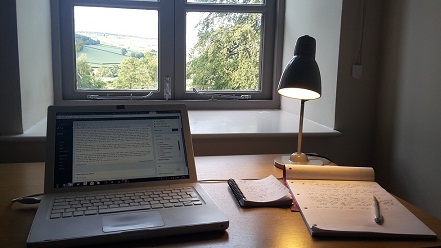
As I looked out over the beautiful Shropshire hills, with swallows launching and docking in regular sorties, it all took a while (and not a few walks) to seep into this city-slicker and draw me down to a slower, less distracted state of mind. Once I’m in that state, my head then enters the parallel universe of my writing, and my real surroundings become scarcely of any importance at all, with the worlds in my head receiving all attention.
That is the joy, and the irony, of the writer’s retreat.
Entry Filed under: Observation & Musing
January 5, 2017
It’s been another while, a long one …
and whiles are never uneventful, are they?
But …
new blog server, new book.
Ready to rock again.
Entry Filed under: Writing
March 22, 2014
A friend recommended Sidney Lumet’s book to me. I found in it this fascinating quote that chimes with me, and probably any writer who has completed a work. It is one more that sums up the journey, from one who’s been through it many times.
“Creative work is very hard, and some sort of self-deception is necessary simply in order to begin. To start, you have to believe that it’s going to turn out well. And so often it doesn’t. I’ve talked to novelists, conductors, painters about this. Unfailingly, they all admitted that self-deception was important to them. Perhaps a better word is ‘belief.’ But I tend to be a bit more cynical about it …
[...]
All good work is self-revelation. When you’ve deceived yourself, you wind up feeling very foolish indeed. You dove into the pool, but there was no water there. Perfect Buster Keaton.
Another great danger in self-deception is that it easily leads to pretension [...] the feeling that we own the work, that it exists only because of us, that we are the vessel through which some divine message is being passed is lunacy.”
Entry Filed under: Observation & Musing
November 19, 2013
Just a note to keep you up to date on a few items, before I go quiet again for a while.
Crowdfunding:
The indiegogo campaign to fund the writing of the next novel in The Genaform Legacy series has, as expected, failed to reach its target. Thanks to those rare few who contributed. The majority of comments and contacts I received were from people offering to “help” make my campaign a success … for a fee. How nice. It leaves me with the sobering feeling that on the Internet – and perhaps the world as a whole – the number of people looking to make money off the back of other people’s efforts far outweighs the number of people willing to pay and contribute for those efforts. It is perhaps what got the world to where we are today and will set its course for the future also.
Retreat:
For my holiday I took a week in a writing retreat. It was a new experience for me. It was great to be in a community of like-minded (but very different) people. The atmosphere of a community where everyone is involved in a creative effort really makes it easier to focus on writing. I blasted through a few rough draft chapters of a new thriller. Alas, it has not been so easy to continue that once I returned because I had to focus on returning to real, paying work. But as it was part of a holiday I didn’t feel any pressure and it and reminds me that I’m doing this ’cause I ENJOY it. It’s great to feel a new story race away under your fingertips.
Screenwriting:
Yesterday I submitted my first screenplay to the BBC Writers’ Room. I’m not expecting success, but … see below.
Broken Evolution:
I’ve tried every option with this, one by one, now leading to the final nuclear option of giving my work away. I gave it away on iTunes because I couldn’t be bothered with the rigmarole of setting up a U.S. Tax ID. The unintended consequence of this is that Amazon lists the Kindle edition as free if it is available free on other eStores. This is not a bad thing for me right now, because by far the greatest number of downloads have happened under the KDP Select promotional giveaways. So having it perpetually free will achieve the primary goal of getting the story in the hands of the greatest number of readers possible. A few downloads a day is thousands of readers over years – thousands more that will have heard of me and potentially be spreading word. I remind myself I’m in this for the long game now.
There have been a couple of additional praising comments too that offset the bad vibes that got to me not so long ago. Some people just get it. They actually get the importance of the story, of what I was trying to achieve. That gives me hope.
A final revised edition with some minor corrections has been uploaded. I’ve done all I can with this now. Done it to death. It has had a hold over me and I have held on to it. And now … I’m letting it go. Free. It feels like capitulation, but on the other hand, there’s this resonating bit of wisdom from Scott Adams. When I read it, I recognized everything I have come to learn on this journey.
If you drill down on any success story, you always discover that luck was a huge part of it. You can’t control luck, but you can move from a game with bad odds to one with better odds. You can make it easier for luck to find you. The most useful thing you can do is stay in the game. If your current get-rich project fails, take what you learned and try something else. Keep repeating until something lucky happens. The universe has plenty of luck to go around; you just need to keep your hand raised until it’s your turn. It helps to see failure as a road and not a wall.
Softly, Softly, Catchee Monkey.
Entry Filed under: Indie-Publishing
September 18, 2013
I mentioned earlier my interest in the trend of indie authors resorting to crowdfunding for their writing projects. In fact, I’m trying it myself and will report back with findings. There are some obvious attractions of crowdfunding for authors:
- It’s an extra source of promotion about your work, which costs nothing to setup. (Some work is required, but relatively little compared with, say, writing a novel!)
- It’s a way of verifying interest in a project before spending all the time completing it.
- If funding is achieved, it’s better than a literary advance – the amount is guaranteed, and you can fund yourself through the initial writing process.
- Funding rewards usually involve giving donors a copy of your book – so you will automatically have books in the hands of several readers the day it is published.
I call it front-loaded promotion.
Point 1 alone makes it a “no-brainer”, however the “if” in point 3 is a mighty big word. Approximately 60% of campaigns fail to meet their funding targets.
I’ve found some information on my way to launching my own campaign that might be useful to others going the same route. Here’s what I’ve discovered about how to maximize your chances of a successful campaign:
Which crowdfunding site to use
There are a few to choose from: kickstarter.com, indiegogo.com, rockethub.com, pozible.com, fundit.ie. Kickstarter is the one to choose. It’s the most popular, attracting most visitors, and has a better success rate for funding publishing projects than the next most popular (indiegogo). There are also more hashtags and retweeters available for kickstarter projects. However only US/UK residents can currently receive funds from Kickstarter. Since that excludes me, I went with the next most popular – indiegogo – which can make payments to anyone via a PayPal account.
Which project to launch
This is the question. You might have a clear idea what you want funded, but will funders find it appealing? Think of it as a product you are selling – the same rules apply. Authors are at a disadvantage here, especially ones without a track record. How will funders know what the book will be like? Do you know what is about yet – can you explain it to them simply? How do they even know you can write? Put up some samples, or links to previous work to build interest and confidence in your credentials to write. For graphic novels, illustrations are great way to instantly see what the story and style will be like.
If you have a number of possible projects in mind, pick the most suitable for crowdfunding. Not all publishing projects are easy to sell – first times books from unknown authors especially so. If you have other, similar books, or others in the series, consider pitching the next in the series.
Most of all, it has to be something people can relate to, and get enthused about. Try to engage people’s emotions. Fun is great way of attracting interest. Many of the successful publishing projects are quirky, humorous tales, or personal stories that special interest groups can immediately relate to.
In many ways, it is like pitching to an agent or publisher. You should apply the same level of thought and rigor. The big differences are pitching in multimedia and you can offer bribes (er, I mean “rewards”) for acceptance*. More on these later.
(* Although I have heard of some agents receiving sweets in the mail with manuscript submissions)
How much funding to ask for
You set a funding target. You have a choice on some crowdfunding sites of whether to accept any money that is contributed, or to only receive funding if the target is reached. The contribution amount can be determined by the donor, but to attract contributions you set up “rewards” or “perks” that you deliver to the donor. If being able to deliver the rewards at the agreed time is dependent on hitting the funding target, you should consider the latter option.
Most of the writing projects are in $1000 – $10000 target range. Of course, the lower you look for, the more likely you are to successfully hit the funding target, but don’t pick a target so low it adversely affects your own ability to deliver on the rewards. Most publishing projects aim for the middle of that range (which is still fairly attractive in comparison with the industry norm royalty advances.)
Best rewards to offer
So you’ve got a project that interests funders – now to really hook them. Rewards should also engage funders emotionally. We’re more likely to open our wallets for something that will make us feel positive, i.e special. Sure, you can offer an ebook or a printed copy of the final book as a “reward”, but it’s not really, is it? Anyone can buy a book once it’s published. That doesn’t make an advance-funder feel special. A reward implies something that the funder receives especially for jumping on-board early and backing the project. Look around at most publishing projects and you’ll see that signed copies and mentions in the credits are the lower-end rewards most funders expect to see, but that’s only the start.
The higher the reward, the more special (approaching unique) it needs to be. Such rewards might cost you more in terms of time and/or money to deliver. Offer something unique to your proposition – something only your project can. Something that will make a funder think “ooh, I have to have that.” I my case – a book about genetics – I came across DNA art and figured I could print that as part of the jacket cover as a reward. Rewards unique to your project can become a selling hook – something intriguing to fit in a tweet or a press release headline. You’ll need to get creative as the stakes rise. Get your thinking cap on!
My final point on rewards is that scarcity also creates interest. Funders are more likely to buy rewards that not everyone can have. Consider limiting the amount of even one or two of the lower level rewards – these are more likely sell out first and so create a scarcity buzz.
How to present the project
This is the important bit: what the potential funder sees on the campaign page. You only get one chance to make a first impression. Take the time to get it right before launch.
1. The Proposition
Quite simply, tell the funder:
- Who you are
- What you will be doing
- Why you are doing it
- What you need to do it
- What they will get out of it
- When they will get it
2. Media
A lot of words explaining the campaign proposition are probably not going to entice most viewers. Images and Videos are the best way to attract that first attention, even though you do need to cover all the details in a text description too. Writers especially need to ensure they include a good textual pitch also, to prove they are good writers!
Video is the best visual hook. Whether to do a campaign video or just images is up to you. Campaigns with video usually attract more attention. It is also a good way to present yourself and let the funders get to know you, what you’re like, whether you seem trustworthy, passionate, etc. Remember that most communication is visual, not verbal. If you’re not comfortable with video of yourself or think you’re not suitable to sell your own projects then don’t sabotage your own pitch! Get a friend to do a funny pitch, or just build a montage of images, do a voiceover, sketch some cartoons, whatever you think is best – just keep it entertaining.
3. Be open about the risks
Tell the viewer what will happen is the funding isn’t met. Tell them what the risks and challenges are in delivering the rewards even if funding is met. Be open and honest about this. Remember, you are asking a stranger for money up-front, with only a promise to deliver on it. They need to know what the chances are you won’t deliver. Be honest in how you present the project and the risks and they are more likely to trust you and contribute money.
4. A team of one
Having a team on-board the project is an advantage because funders will see less risk if there’s many people behind the delivery. Put a small bio and picture of each team member on the campaign page so people can relate to the team members.
Standalone Indie authors are definitely at a disadvantage here. In most cases, only the one author can deliver on the promised book, so the perceived risks of the project not being delivered are higher. It’s hard to avoid that fact, unless you can include an illustrator or the book can be co-authored.
Getting the word out
So once you have your campaign page all ready and are about to hit the launch button – don’t. If you have experience of self-publishing a book you will know that nothing will happen. You need to work pro-actively to sell your crowdfunded project as if (and harder) than you would promote to sell your book. It’s beyond the scope of this post to cover it, but engage the usual channels – tell friends and family, use social media, bloggers, etc. If you have a list of readers for your previous work, you are at an advantage over first-time writers. Many fan readers will pay up-front to get a sequel ASAP.
Finally, remember that you have a limited time from campaign launch to meet the funding target, so make sure all your marketing ducks are in a row, ready to go, before you hit that launch button.
Here are some more links with tips to help you out:
Dollar for dollar raised, Kickstarter dominates Indiegogo SIX times over.
How to Use Kickstarter to fund your publishing project.
Hacking Kickstarter: How to Raise $100,000 in 10 Days
In spite of all this, don’t expect success. Ironically, even the Indie Publishing Guide couldn’t fund itself on Kickstarter.
My new motto is plan for the best, prepare for the worst: that way, whatever the outcome, you’ll never be disappointed.
Good Luck!
(Oh, and please drop a few coppers into my crowdfunding page – go on, you know you want to prove me wrong!)
Entry Filed under: Indie-Publishing
September 11, 2013
I’ve been out of touch with the publishing grapevine up until recently, but some interesting items have just crossed my radar.
Firstly, it seems the innovation that was to destroy the dead trees publishing business – the ebook – well … isn’t. As novelty fades and reality invades, ebook sales seem to be reaching a plateau, at about 20-25% of the book market. What’s even more interesting is that the reason for that share seems to be a certain genre of book. I don’t remember any of the futurists predicting the ebook would be the high-tech alternative to the magazine slipped in front of the naughty book cover!
Also, I’m seeing more and more ereader apps and services appearing around the world (I even interviewed for one). The latest take on this phenomenon is Oyster books which is adopting the Netflix model – all you can read for a monthly subscription fee. Time will tell how it goes, but only the very avid reader (or short subscriber!) could reap financial benefit from that model.
The last item is the most interesting to me because I have, independently, been thinking about utilizing the latest trend in indie publishing – crowdfunding. How to go about it, and how well it works for most, are topics for another blog post. Suffice it to say for now that the really interesting thing is when you see stories like this one, where an author overshot his project target by a mere half million dollars. It actually sounds like a very innovative project, which is one of the valid reasons for the campaign’s success – but $580,000? It just reminds me of the bubble in indie ebook publishing that started with the successes of early adopters in kindle self-publishing. I wonder, will we see the kickstarted equivalent of JA Konrath soon publishing an ebook telling us how we can all make a fortune publishing the crowdfunded way? It’s inevitable. Heck, it might even be me writing that ebook! Survivor bias striking again. I’d better get in fast before that new avenue gets over-saturated too!
Entry Filed under: Indie-Publishing